In 2024, crypto investment scams siphoned at least $9.9 billion in on-chain inflows — a lower-bound figure that rises as investigators attribute more wallets. The fraud industry is getting faster and more professionalized, outpacing regulators’ public warnings.
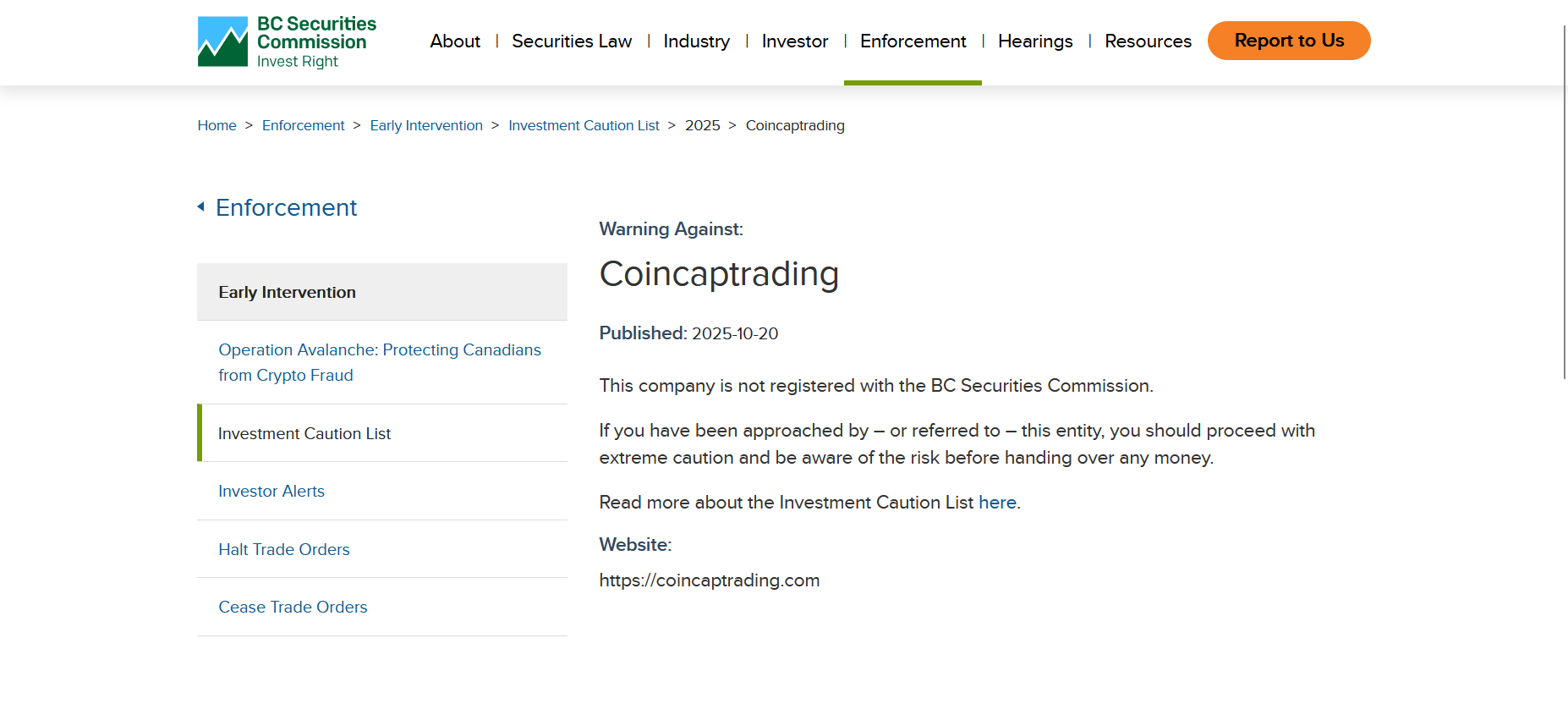
Coincaptrading was added to the BCSC Investment Caution List on October 20, 2025. The regulator says the firm is not registered in British Columbia and warns investors to proceed with extreme caution. The BCSC page ties the operation to coincaptrading.com.
What the company claims to offer (site footprint)
The site pitches quick onboarding (“Open Account → Deposit → Start Trading”), “guaranteed weekly income,” and a low-friction “one low fee” promise — classic regulation theater designed to mimic legitimate platforms while cultivating unrealistic return expectations.
How they lure victims (observed pattern across BCSC-flagged shops)
- Ad → landing page → messenger: Paid social or search pushes users to lead forms, then to WhatsApp/Telegram “advisers.”
- Performance theatre: Dashboards and screenshots of “win rates” or “weekly income” justify repeat top-ups.
- Authority mimicry: Generic risk disclaimers and global-sounding language suggest oversight that doesn’t exist — the BCSC lists Coincaptrading on its caution list and confirms no registration.
Mechanics of the fraud (typical sequence)
- Frictionless deposits; blocked withdrawals — payouts are stalled behind “compliance checks,” unlock fees, or “tax reserves.”
- Escalation pressure — “analysts” push larger deposits to recover losses or unlock “pro tiers.”
- Silence/suspension — when victims question licensing or refuse new fees, access is throttled or suspended.
Regulator status (BCSC): “This company is not registered with the BC Securities Commission.” Published: 2025-10-20. Website: coincaptrading.com.
Victim Story (Case Study)
“Daniel,” 58, Metro Vancouver — total loss: C$34,500
Daniel saw a Facebook ad touting “guaranteed weekly income.” After a consultation by WhatsApp, he deposited C$1,500. His dashboard showed steady “wins”; a “senior strategist” urged a VIP tier for better spreads. Over six weeks he sent C$34,500 via card and crypto.
When Daniel tried to withdraw C$5,000, support demanded a 15% “regulatory reserve.” After he refused, his account was placed into “enhanced AML review,” and all communication slowed. Daniel reports anxiety, insomnia, and shame — emotional fallout consistent with investment-fraud survivors.
(Composite/anonymized; mirrors patterns documented across BCSC-flagged entities.)
Our Investigative Findings
- Primary source — BCSC: Coincaptrading is on the Investment Caution List (Published Oct 20, 2025) with the linked site coincaptrading.com and a warning that it is not registered in BCSC.
- Policy context — Why this matters: The BCSC’s caution list flags entities that are unregistered, promote questionable investments, or impersonate legitimate firms. If you deal with them, you’re outside normal Canadian protections.
- Macro fraud backdrop: Chainalysis reports $9.9B in 2024 scam inflows and a ~40% YoY surge in relationship-based “pig-butchering” schemes, amplified by AI tooling.
Immediate Actions & Recovery Pathway
Immediate Actions (Hour 0–48)
- Stop further payments
Freeze card/fintech/crypto transfers — especially any “unlock fee,” “tax prepayment,” or “security reserve.” - Preserve evidence
Export account statements, chat logs, emails (with full headers), dashboard screenshots, wallet addresses/txids, and any KYC you submitted.
Record the BCSC-listed identifier: coincaptrading.com (Published Oct 20, 2025). BCSC - Notify your bank/processor
Open a fraud dispute/chargeback; request a case reference. For crypto, collect txids and exchange account IDs. - Regulator & law-enforcement reports (Canada-first)
- BCSC Caution List hub & reporting guidance: https://www.bcsc.bc.ca/enforcement/early-intervention/investment-caution-list
- CSA Investor Alerts index (for cross-province checks): https://www.securities-administrators.ca/investor-alerts/
- If funds moved via crypto, keep txids for Melmac Solutions and exchange escalations.
- Secure devices & accounts
Change passwords; enable 2FA; revoke any API keys or exchange withdrawal whitelists you shared.
How Melmac Solutions (via ScamFindings) Fits In — Step by Step
Step A — Free Intake & Triage
Start here: We validate the BCSC entry, map payment rails, and pick the fastest recovery lane (bank/fintech dispute, exchange escalation, or civil route).
Step B — Forensic Wallet Trace (if crypto used)
We trace on-chain flows from your txids to exchanges/bridges and prepare an Exchange Disclosure Package (EDP) for compliance teams.
Step C — Exchange & Platform Escalations
We send structured notices to identified venues to flag/preserve assets and evidence. For cards/fintech, we draft scheme-aligned dispute narratives emphasizing deception.
Step D — Regulator/Law-Enforcement Pack
A concise brief (timeline, counterparties, evidence map) to attach to your BCSC/CSA filings and police reports.
Step E — Civil Options (as needed)
If funds touched identifiable entities, we connect you with vetted counsel for injunctions or disclosure orders and forensic for direct asset freeze.
Learn more: How to report crypto scam in 2025
FAQs: Coincaptrading
Is Coincaptrading registered in Canada?
No. The BCSC lists Coincaptrading on its Investment Caution List and states it is not registered in BC. Date: Oct 20, 2025. Website: coincaptrading.com.
The site mentions “guaranteed weekly income.” Is that a red flag?
Yes. Guaranteed returns are a hallmark of fraud. The BCSC flags such entities precisely because they operate without registration and make questionable claims.
Can I get my money back?
It depends on speed, evidence quality, and whether funds touched compliant banks or exchanges. A wallet trace can reveal venues for notices, subpoenas or asset freeze.
How do I report this in BC?
Use the contact/complaint options linked from the BCSC Investment Caution List page (online complaint form, phone, or email). Keep your evidence bundle ready.
Why is the BCSC caution list a big deal?
Because it means the entity is not registered to deal or advise in BC and may be promoting risky or fraudulent investments; normal protections don’t apply.